Modern fitness culture often reduces yoga to “just stretching.” Scroll through social media and you’ll see advanced poses, flexible bodies, and aesthetic routines that make yoga look like a flexibility contest. But the real science of yoga goes far beyond touching your toes or improving mobility. Yoga affects the nervous system, brain chemistry, breathing patterns, stress hormones, muscular endurance, posture, sleep quality, emotional regulation, and even long-term mental resilience.
Research from the World Health Organization shows that physical inactivity is becoming one of the largest global health risks, with nearly one-third of adults not meeting recommended activity levels. At the same time, studies published in 2025 continue to explore yoga’s impact on cognition, emotional balance, stress recovery, and physiological health.
For people searching terms like “best yoga class in Kolkata,” “yoga class in Kankurgachi,” “stress relief yoga,” “yoga for posture correction,” and “mental wellness yoga,” the growing interest is not accidental. People are beginning to understand that yoga is not merely exercise-it is a complete mind-body system.
The Biggest Misconception About Yoga
One of the most common misunderstandings about yoga is the belief that it is simply a stretching routine. This idea usually comes from seeing yoga poses on Instagram or short social media clips where flexibility is highlighted more than functionality. A person folds forward, bends backward, or twists deeply, and the audience assumes yoga is only about mobility. That assumption is incomplete. Stretching is merely one small component of yoga, just as lifting weights is only one component of athletic performance. Yoga combines movement, controlled breathing, mindfulness, balance, muscular activation, and nervous system regulation into one integrated practice.
The difference becomes obvious when you compare passive stretching with yoga practice. In normal stretching, you lengthen a muscle for flexibility. In yoga, the body and brain work together simultaneously. You regulate breathing, stabilize muscles, maintain alignment, and engage mental focus while moving through postures. That changes the physiological response completely. A yoga session influences heart rate variability, stress response, circulation, and mental clarity in ways simple stretching does not. This is one reason why people often say they “feel different” after yoga, not just physically loose.
Scientific studies are increasingly supporting this broader understanding. Research published in 2025 explored how yoga-based practices affect cognitive, psychological, and physiological outcomes over the long term. These findings reinforce what experienced practitioners have known for years: yoga trains the entire human system, not just muscles. That is why yoga is now recommended alongside fitness programs, stress management plans, workplace wellness initiatives, and mental health interventions.
For people attending a yoga class in Kolkata or joining beginner sessions at Yoga With Sandy, the first surprise is often how mentally refreshing yoga feels. Students enter expecting flexibility exercises and leave realizing that yoga influences breathing patterns, focus, emotional calmness, and overall energy levels. That transformation is where the real science of yoga begins.
The Science Behind Yoga and the Nervous System
The human nervous system constantly shifts between two major states: the sympathetic system, commonly known as “fight or flight,” and the parasympathetic system, often called “rest and recovery.” Modern urban lifestyles keep many people stuck in chronic stress mode. Notifications, deadlines, traffic, poor sleep, excessive screen time, and mental overload create continuous stimulation. Yoga acts as a reset mechanism for this overstimulated system.
Controlled breathing techniques used in yoga directly influence the autonomic nervous system. Slow breathing patterns can reduce stress markers and improve emotional regulation. A 2025 EEG-based study on paced breathing demonstrated measurable effects on resilience and stress regulation. This matters because breathing is one of the few bodily systems that operates both automatically and consciously. Through yoga breathing practices like pranayama, people can intentionally influence their physiological state.
Think about how your breath changes when you are anxious. It becomes shallow, rapid, and irregular. Yoga reverses that pattern. Slow diaphragmatic breathing sends signals to the brain that the body is safe, reducing excessive stress responses. This lowers muscular tension, improves oxygen efficiency, and enhances mental calmness. That is why yoga practitioners frequently describe a sense of groundedness after class.
The effect becomes even more important in high-pressure environments. Professionals working long hours often experience mental fatigue without realizing how deeply stress affects posture, sleep, digestion, and concentration. Research involving software engineers in 2025 explored yoga-based workplace interventions for well-being. While quantitative improvements varied, participants consistently reported feeling calmer, mentally refreshed, and emotionally balanced. That reflects yoga’s role as a nervous system regulation tool rather than just physical activity.
This is also why many people now search for terms like “stress relief yoga classes,” “beginner yoga near me,” and “yoga class in Kankurgachi.” They are not only seeking fitness. They are searching for recovery from mental overload.
Yoga and Brain Function
The brain responds to repeated experiences by forming new neural pathways, a process known as neuroplasticity. Yoga supports this process through the combination of movement, breath control, focus, and mindfulness. Unlike repetitive gym routines where the mind may wander, yoga encourages sustained awareness of the body and breath. That mindfulness creates stronger connections between mental attention and physical sensation.
Research increasingly suggests that yoga can influence emotional regulation and cognitive function. Discussions around yoga’s relationship with GABA activity, mindfulness, and stress reduction continue gaining attention in neuroscience and psychology communities. People who practice yoga consistently often report improved concentration, emotional stability, and reduced anxiety. These effects are not magical or mystical; they are linked to how yoga trains attention and physiological regulation simultaneously.
Consider the average modern lifestyle. Most people spend hours multitasking, switching between screens, conversations, and responsibilities. The brain rarely rests. Yoga interrupts this cycle by slowing sensory overload. Holding a posture while focusing on breathing creates a state similar to active meditation. The mind gradually shifts from scattered thinking to concentrated awareness. Over time, this can improve emotional resilience.
Yoga’s influence on mental health is particularly relevant today. WHO reports emphasize that physical activity contributes to reduced symptoms of depression and anxiety while improving overall well-being. Yoga adds an additional layer because it combines movement with mindfulness and breathing. That combination can feel deeply restorative for people dealing with stress-heavy lifestyles.
Students attending Yoga With Sandy often describe the mental changes before the physical ones. Better sleep, improved patience, reduced irritability, and enhanced focus frequently appear before dramatic flexibility improvements. That pattern highlights something important: yoga works from the inside out. Flexibility is visible, but nervous system and cognitive benefits are often the deeper transformation.
The Physical Benefits Beyond Flexibility
Yoga certainly improves flexibility, but limiting yoga to flexibility alone is like calling a smartphone “just a flashlight.” The body adaptations created by yoga are far more complex. Yoga develops muscular endurance, balance, joint stability, coordination, mobility, posture, and controlled strength. Many yoga poses require supporting body weight through sustained muscular engagement, which activates stabilizing muscles often ignored in conventional workouts.
Poses like Plank, Chaturanga, Warrior sequences, and Chair Pose build significant functional strength. Unlike isolated gym exercises that target one muscle group, yoga movements typically recruit multiple muscle systems together. This integrated activation improves movement efficiency and body awareness. That is one reason athletes increasingly include yoga in their training programs. Yoga improves mobility while maintaining stability, reducing injury risk and improving recovery.
Posture correction is another major benefit. Hours spent sitting at desks create tight hips, rounded shoulders, weak core muscles, and neck strain. Yoga counteracts these imbalances by strengthening postural muscles and increasing spinal mobility. Office workers frequently experience reduced back pain and improved alignment after consistent practice. For urban professionals in Kolkata dealing with long commutes and sedentary work, yoga becomes almost like maintenance for the body.
Why Desk Workers Need Yoga
The average desk worker spends several hours daily in compressed postures. Over time, this affects circulation, breathing mechanics, and spinal health. Forward head posture, tight hip flexors, and restricted chest mobility become common. Yoga addresses these patterns systematically through stretches, strengthening exercises, and breathing practices.
Here’s a simple comparison of how yoga helps common desk-related problems:
| Desk-Related Issue | How Yoga Helps |
|---|---|
| Neck stiffness | Improves mobility and posture |
| Lower back pain | Strengthens core and spinal muscles |
| Tight hips | Restores hip flexibility and circulation |
| Poor posture | Enhances alignment awareness |
| Mental fatigue | Activates relaxation response |
| Shallow breathing | Expands lung capacity and breath control |
This is why searches like “yoga for posture correction,” “corporate yoga classes,” and “best yoga class in Kolkata” continue growing. Modern work culture creates physical problems that yoga directly addresses.
Yoga and Hormonal Balance
Hormones operate like the body’s internal messaging system. Stress, sleep quality, physical activity, and emotional state all influence hormonal balance. Yoga supports this system primarily by reducing chronic stress responses. When the body remains in prolonged stress mode, cortisol levels stay elevated. Over time, high cortisol can contribute to poor sleep, fatigue, anxiety, weight gain, reduced immunity, and mood disturbances.
Yoga helps regulate cortisol through breath control, relaxation, and parasympathetic activation. Unlike high-intensity exercise, yoga often lowers stimulation while still improving circulation and muscular engagement. This makes yoga particularly valuable for people already dealing with stress overload. A calming yoga session can function almost like pressing the reset button on the nervous system.
Sleep improvement is another major effect. Many people struggle with poor sleep not because they lack exhaustion, but because their nervous systems never fully switch off. Yoga practices involving breathwork and slow movement help reduce mental restlessness before bedtime. Students frequently report falling asleep faster and waking up with better energy after regular yoga practice.
WHO data continues emphasizing the relationship between physical activity, mental health, and overall well-being. Yoga contributes uniquely because it blends movement with recovery-oriented practices. Instead of only exhausting the body, yoga teaches the body how to recover efficiently.
For people joining a yoga class in Kankurgachi or starting sessions with Yoga With Sandy, these benefits often become noticeable within weeks. Better sleep, calmer reactions, improved digestion, and higher daily energy frequently appear before dramatic body transformations. That gradual internal shift is part of yoga’s scientific foundation.
Yoga as Preventive Healthcare
Healthcare systems worldwide increasingly recognize the importance of prevention rather than only treatment. Yoga fits naturally into preventive healthcare because it addresses multiple lifestyle-related risk factors simultaneously. Physical inactivity, poor posture, chronic stress, anxiety, and sedentary behavior contribute to many modern health issues. WHO estimates that millions of deaths could be prevented annually through increased physical activity.
Yoga encourages sustainable movement patterns without extreme physical strain. That makes it accessible across age groups and fitness levels. Unlike some exercise programs that feel intimidating or exhausting, yoga can be adapted for beginners, seniors, office workers, athletes, and even individuals recovering from injury. This adaptability explains why yoga participation continues growing globally.
Mental wellness is another important factor. Anxiety and burnout are becoming increasingly common, especially among urban professionals. Yoga provides a structured method for slowing down, reconnecting with the body, and improving emotional regulation. Community discussions frequently highlight yoga’s role in improving confidence, reducing anxiety, and creating emotional stability.
The conversation around yoga is also evolving scientifically. While critics sometimes dismiss yoga as “only stretching,” research continues demonstrating measurable benefits in stress regulation, mobility, mental wellness, and nervous system recovery. Yoga should not replace all forms of exercise, but it serves as a highly effective complement to modern lifestyles.
That is why many wellness-focused individuals in Kolkata now combine yoga with strength training, walking, or cardio routines. Yoga fills the recovery and regulation gap that many intense fitness programs overlook.
The Rise of Yoga in Urban India
Urban India is experiencing a major wellness shift. More people are prioritizing mental health, posture correction, stress management, and sustainable fitness rather than purely aesthetic goals. This cultural change is one reason yoga studios and wellness communities continue expanding across cities like Kolkata.
Professionals working hybrid jobs often experience digital fatigue and reduced physical activity. Long commutes, irregular eating schedules, and extended screen time create chronic stress patterns. Yoga offers something many modern workouts do not: restoration alongside movement. Instead of leaving people drained, yoga often leaves them energized and mentally clearer.
This growing awareness has increased demand for quality instruction. Searches related to “yoga class in Kolkata,” “best yoga teacher near me,” “beginner yoga classes,” and “yoga class in Kankurgachi” continue gaining traction because people want guided, personalized practice rather than random online routines.
At Yoga With Sandy, this shift reflects broader lifestyle changes. Students are no longer attending yoga only for weight loss or flexibility. Many join to improve sleep, reduce stress, enhance mobility, manage posture issues, or simply create healthier routines. Parents, working professionals, seniors, and students now approach yoga as a long-term wellness investment rather than a temporary fitness trend.
This mirrors global conversations around yoga accessibility as well. Recent discussions emphasize that yoga is for every body type, age group, and experience level-not only flexible athletes or advanced practitioners. The science supports that inclusive perspective because yoga’s benefits extend far beyond physical appearance.
Choosing the Right Yoga Practice
Not all yoga styles are identical. Different approaches serve different goals, and understanding these differences helps people choose practices that match their needs. Some yoga forms focus more on strength and movement, while others emphasize relaxation and recovery.
| Yoga Style | Main Focus | Best For |
|---|---|---|
| Hatha Yoga | Foundational poses and breath | Beginners |
| Ashtanga Yoga | Structured dynamic flow | Discipline and stamina |
| Vinyasa Yoga | Continuous movement | Fitness and coordination |
| Yin Yoga | Deep relaxation and mobility | Stress relief and flexibility |
| Power Yoga | Strength-focused sequences | Conditioning and endurance |
| Restorative Yoga | Recovery and nervous system relaxation | Burnout and stress management |
Choosing the right teacher matters just as much as choosing the right style. A skilled instructor understands alignment, breathing, modifications, and progression. Good teaching creates safety, consistency, and long-term improvement rather than pushing people into advanced poses too quickly.
For beginners searching “yoga class in Kolkata” or “yoga class in Kankurgachi,” finding a teacher who prioritizes education and sustainable practice is essential. The best yoga experiences are not about performing impressive poses; they are about learning how to move, breathe, and recover effectively.
Conclusion
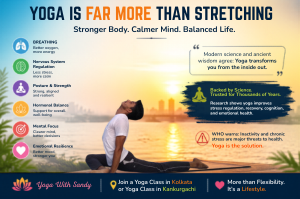
Yoga is far more than stretching because the human body is far more than muscles and joints. Yoga works through interconnected systems-breathing, nervous system regulation, posture, strength, hormonal balance, mental focus, and emotional resilience. Flexibility may be the most visible outcome, but the deeper transformations happen internally.
Modern science increasingly supports what traditional yoga systems have emphasized for centuries: movement and breath can profoundly influence physical and mental well-being. Research continues exploring yoga’s effects on cognition, stress regulation, recovery, and emotional health. Combined with WHO findings about the dangers of inactivity and stress-heavy lifestyles, yoga’s relevance today is stronger than ever.
Whether someone joins Yoga With Sandy, attends a yoga class in Kolkata, or begins practicing at a yoga class in Kankurgachi, the goal should not simply be becoming flexible. The goal is creating a healthier, calmer, stronger, and more balanced life.
FAQs
1. Is yoga scientifically proven to reduce stress?
Yes. Multiple studies show yoga and controlled breathing can reduce stress markers, improve emotional regulation, and support nervous system recovery.
2. Can yoga replace gym workouts?
Yoga can improve strength, mobility, balance, and endurance, but it does not fully replace all forms of resistance or cardiovascular training. Many people combine yoga with gym workouts for balanced fitness.
3. How often should beginners practice yoga?
Beginners usually benefit from practicing 2–3 times weekly. Consistency matters more than intensity when starting yoga.
4. Is yoga helpful for office workers?
Absolutely. Yoga improves posture, reduces stiffness, enhances mobility, and helps counteract the effects of prolonged sitting and screen exposure.
5. Which yoga style is best for stress relief?
Gentle Hatha Yoga, Yin Yoga, Restorative Yoga, and breath-focused practices are especially effective for stress management and relaxation.
