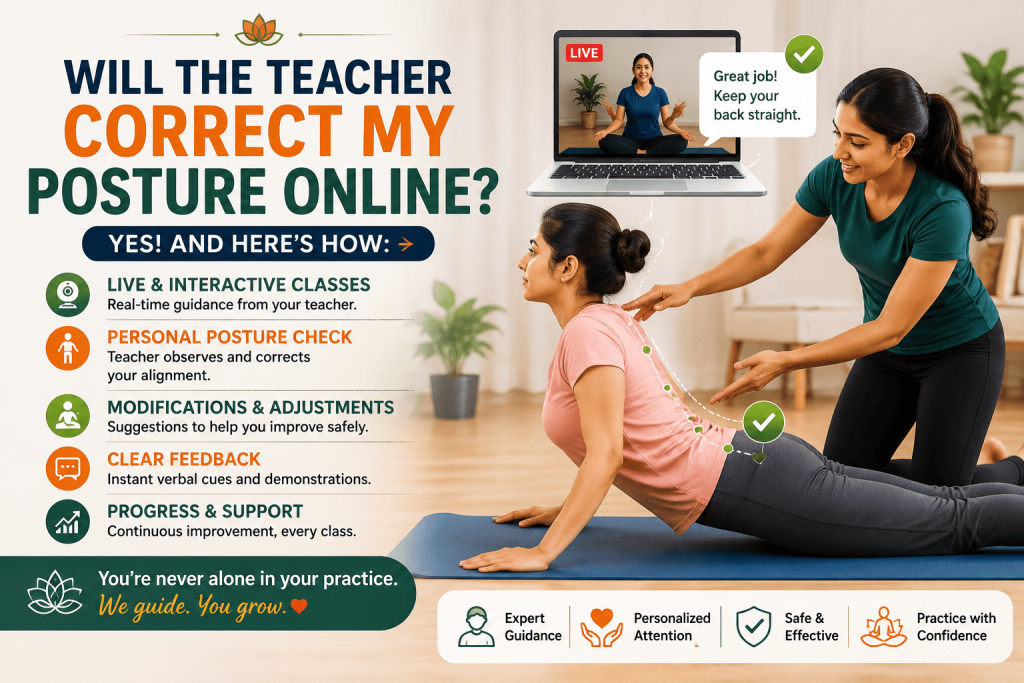
If you have ever looked at an online yoga class and wondered, “But how will the teacher know if I am doing the pose correctly?”, you are definitely not alone. It is one of the most natural questions to ask before joining a live online yoga class, especially if you are a beginner or you have previously learned yoga only inside a physical studio. You may imagine yourself sitting in front of a laptop, copying the instructor on screen, and hoping your knees, hips, shoulders, and spine are all in the right position. But there is a major difference between watching a random yoga video and participating in a live, interactive yoga class where your teacher can actually see you, communicate with you, and respond to what your body is doing in real time. With the right camera position, lighting, class size, and teaching approach, an online teacher can observe your movement and give immediate verbal and visual corrections. This is particularly useful for students searching for a yoga class in Kankurgachi, a yoga class in Kolkata, or even an online yoga class near you because you do not necessarily need to travel to a physical yoga studio to receive meaningful guidance. WHO’s latest 2026 discussion of yoga also emphasizes its adaptability and accessibility for people of different ages and abilities, while recognizing benefits related to balance, flexibility, strength, mobility, and overall well-being.
Why Posture Correction Matters in Online Yoga
Good yoga practice is not simply about touching your toes, holding a difficult pose, or making your body look like the instructor’s body. Alignment, breathing, stability, awareness, and control are much more important than forcing yourself into a particular shape. Imagine following a recipe while skipping the instructions and only looking at the photograph of the finished dish; you might end up with something that looks similar from a distance, but the process could be completely wrong. Yoga can be approached in much the same way. If your spine is collapsing, your knee is rotating inward, your shoulders are unnecessarily tense, or you are holding your breath, simply copying the teacher’s general shape does not mean you are practicing effectively. This is where posture correction becomes valuable. A good teacher can notice patterns, explain what needs to change, and give you a simple cue that helps your body understand the movement. Sometimes the correction may be as straightforward as lifting the chest, softening the shoulders, moving the feet slightly wider, or keeping the knee aligned with the toes. These small changes can completely alter how a posture feels. For students dealing with long hours of sitting, desk work, or sedentary routines, developing better body awareness during movement can be especially useful. WHO currently reports that physical activity supports muscular and functional health, mental well-being, sleep, and overall quality of life, reinforcing the broader importance of maintaining regular movement rather than remaining sedentary.
The Difference Between a Recorded Video and a Live Yoga Class
A recorded yoga video and a live yoga session may both appear on your screen, but from a student’s perspective they are two very different experiences. A recorded video can demonstrate an exercise beautifully, but it cannot look at your body and say, “Move your right foot slightly forward,” or “Relax your shoulders; you are holding too much tension.” A live class changes that equation because there is communication in both directions. You can ask questions, the teacher can observe your movement, and corrections can happen while you are actually performing the pose. This does not mean an online teacher has magical vision or can see every detail perfectly; camera angle, lighting, distance, internet quality, clothing, and class size all influence what the instructor can observe. That is why professional online yoga instruction should include guidance on camera placement and encourage students to create enough space to show the body clearly. Current online yoga offerings in India also commonly position real-time posture correction and personal guidance as major distinctions between live classes and pre-recorded content.
How a Teacher Sees Your Alignment Through the Camera
Your camera essentially becomes a small window into your practice. If it is positioned correctly, your teacher can observe important aspects of your movement, including the general position of your spine, shoulders, arms, hips, knees, and feet. For standing postures, a wider frame that shows your entire body is usually more useful than a close-up of your face. During seated or floor-based movements, the camera may need to be positioned differently so the instructor can still see the relevant body areas. Think of it like giving your teacher a virtual yoga mat inside your screen; the clearer the view, the easier it becomes for the teacher to guide you. An experienced yoga teacher will not necessarily interrupt you every few seconds because constant correction can become distracting. Instead, good instruction often combines group-wide cues with individual corrections when something needs particular attention. You might hear a general instruction such as “keep the shoulders away from the ears,” followed by your name and a more specific cue if the teacher notices that you need additional guidance. That combination makes a live online session feel much more interactive than simply pressing play on a video.
How Online Yoga Teachers Correct Your Posture
Posture correction online generally happens through a combination of observation, verbal instruction, demonstration, repetition, and feedback. Suppose you are practising a standing forward fold and your back is rounding more than intended. The teacher may first demonstrate the movement again, then ask you to bend your knees slightly, lengthen through the spine, and avoid forcing your hands toward the floor. If you adjust and the movement becomes more controlled, the teacher can immediately recognize the change. The same process works in many other asanas. During Warrior II, for example, a teacher may remind you to keep the front knee tracking appropriately and maintain awareness through the back leg. During a seated posture, they may notice that you are collapsing through the chest and encourage you to sit taller. The correction is not about making every student look identical; rather, it is about helping each person find a safer and more functional version of the movement that suits their current ability. This individualization is one reason people increasingly search for phrases such as certified yoga teacher, experienced yoga teacher, beginner yoga classes, and yoga teacher near me instead of simply searching for generic yoga videos. The search itself reflects an important shift: students are often looking for guidance, not just content.
Real-Time Verbal Cues and Visual Demonstrations
One of the most effective tools an online teacher has is the simple verbal cue. A good cue does not need to be complicated or filled with technical terminology. Sometimes five clear words can change an entire posture: “Lift your chest,” “Relax your jaw,” “Press through your feet,” or “Keep breathing slowly.” The teacher can combine these instructions with a demonstration so that you hear the correction and see what it means at the same time. This matters because yoga is not purely intellectual; your body needs to experience the adjustment. If you are told to “lengthen the spine” but have no idea what that sensation feels like, the teacher can demonstrate it and then observe your next attempt. Over several repetitions, the correction can become easier to understand. In a live class, this feedback loop happens naturally: you move, the teacher observes, the teacher cues, you adjust, and the teacher observes again. That is fundamentally different from practicing alone with a recording because the instruction responds to you rather than remaining fixed regardless of what you do.
Small Adjustments That Make a Big Difference
Sometimes posture correction involves an adjustment so small that a beginner may initially wonder whether it matters. It does. Moving a foot a few centimeters, changing the direction of the toes, softening the knees, lowering tense shoulders, or redistributing weight can make a posture feel completely different. Think of adjusting a picture frame on a wall: moving it slightly may seem insignificant, but suddenly everything looks balanced. Yoga alignment can work similarly. The objective should not be to chase a perfect shape or compare yourself with another student. Bodies have different proportions, mobility levels, histories, and limitations. A responsible certified yoga teacher should therefore focus on helping you understand your own movement rather than forcing everyone into one rigid template. This is especially important for beginners who may assume that discomfort automatically means a pose is “working.” A teacher can help distinguish between the normal challenge of learning a movement and a situation where you should stop, modify, or seek appropriate professional advice. WHO’s current guidance emphasizes that yoga can be adapted for people of different ages and abilities, which supports the principle that yoga instruction should not be based on a one-size-fits-all approach.
Can Online Yoga Be as Personal as an In-Person Class?
The honest answer is that online and in-person yoga are different experiences, but online does not automatically mean impersonal. In a physical yoga studio, a teacher may have additional opportunities to observe students from different angles and, where appropriate and consented to, provide hands-on adjustments. Online, the instructor relies primarily on visual observation, verbal cues, demonstrations, and communication through the screen. However, that can still create a surprisingly personal learning environment when the class is genuinely live and the teacher pays attention to individual students. A smaller online group can make this easier because the instructor has more opportunity to observe each participant. A private online session can go even further because the entire session can be structured around one student’s goals, experience level, movement patterns, and questions. This is why someone searching for a yoga class near Manicktala, a yoga class near Ultadanga, or a yoga studio in Kolkata does not necessarily have to choose based only on physical distance. If the objective is quality instruction, the more useful question may be: “Will this teacher actually pay attention to me?” A good live class should make you feel seen, guided, and comfortable asking questions instead of feeling like one anonymous person watching a screen.
Individual Attention in a Group Online Session
Group classes can still provide individual attention when the instructor manages the session properly. The teacher may begin with instructions that apply to everyone and then move around the virtual screen mentally, checking students one by one. If someone repeatedly performs a movement incorrectly, the instructor can address the issue directly and explain the correction without embarrassing the student. Over time, the teacher also becomes familiar with students’ habits. They may remember that one student tends to lift the shoulders, another tends to lock the knees, and another needs a slower transition between postures. That familiarity can make future sessions more personalized. Recent local-search research for yoga businesses shows that people are increasingly searching not only for broad terms but also for beginner classes, morning or evening classes, private yoga sessions, yoga instructors, and location-specific services, indicating that search intent is becoming more specific. For a student, this is good news because it means you can look for a class that matches your actual needs rather than joining the first generic yoga video you find.
How to Set Up Your Camera for Better Posture Correction
If you want your online yoga teacher to correct your posture effectively, you also have a role to play. Before class begins, place your phone, tablet, or laptop far enough away that your teacher can see most or all of your body during standing poses. Avoid placing the camera extremely low on the floor or too close to your face because this can hide important alignment details. Try to practise in a reasonably well-lit area and remove objects that block the camera’s view. If possible, use a stable stand rather than balancing your phone against a pile of books that might collapse halfway through class. Your practice area does not need to look like a luxury yoga studio; it simply needs to be safe, spacious, and visible. You can even do a quick camera test before the class starts by standing on your mat and checking whether your hands, feet, and head are visible. During floor poses, you may occasionally need to reposition the camera depending on what you are practising. These small preparations make communication easier and allow the teacher to spend less time saying “I can’t see your feet” and more time actually teaching you. In other words, technology works best when you treat it as a tool rather than expecting it to do all the work.
What Beginners Can Expect From Live Online Yoga
If you have never attended yoga before, joining an online class can feel slightly strange at first. You might worry that everyone else will be flexible, experienced, and confident while you struggle to understand which leg goes where. Take a breath; that is exactly why beginner-friendly instruction matters. A good teacher should explain the basic movement, demonstrate it clearly, give you time to try it, and provide corrections when needed. You do not need to arrive with perfect flexibility, expensive equipment, or years of yoga experience. In fact, beginners often benefit significantly from learning good movement habits from the start instead of first developing poor habits and then trying to correct them later. You may hear instructions about breathing, spinal alignment, foot placement, balance, transitions, and relaxation throughout the session. Some classes may focus more on strength and mobility, while others may emphasize gentle movement, meditation, breathing, or relaxation. WHO’s current 2026 material describes yoga as adaptable and accessible across ages and abilities and highlights its potential contribution to balance, flexibility, strength, mobility, and mental well-being. That makes the central question less about whether online yoga can work and more about whether you have found the right teacher and the right class format for you.
Why Choose a Certified and Experienced Yoga Teacher?
When you search for a yoga teacher near you, the cheapest or closest option is not automatically the best option. Teaching yoga involves more than knowing the names of poses. An experienced instructor should understand how to explain movements, recognize common alignment mistakes, offer appropriate modifications, manage different ability levels, and communicate clearly. A certified yoga teacher can also give you greater confidence that the person guiding your practice has pursued relevant training. Experience matters because teaching improves through working with real people. Every student moves differently, asks different questions, and brings different challenges to the mat. An experienced yoga teacher learns how to explain the same concept in several ways until a student understands it. This becomes particularly important online, where the teacher cannot rely on physical proximity to communicate. The current WHO discussion on yoga also points toward the importance of stronger standards, safety, effectiveness, and inclusivity in yoga instruction worldwide, including its reference to technical work on yoga training standards. So when evaluating a yoga studio, online programme, or individual instructor, look beyond attractive photographs and impressive claims. Ask yourself whether the teacher provides live guidance, explains alignment, welcomes questions, understands beginners, and gives students meaningful feedback.
Yoga With Sandy: Online Guidance From Home
At Yoga With Sandy, the idea behind live online yoga is simple: you should not have to sacrifice personal guidance simply because you are practising from home. During a live session, students can receive real-time instructions, posture checks, demonstrations, and corrections while following the class from their own space. If your back needs to lengthen, your shoulders need to relax, or your feet need to be repositioned, the teacher can explain the adjustment while you are practising rather than waiting until the next class. That interaction can make a huge difference, particularly for students who previously felt nervous about joining yoga because they believed they were “not flexible enough” or would not know whether they were doing a pose correctly. It also gives students outside the immediate neighbourhood an opportunity to learn without travelling. Someone searching for a yoga class in Kankurgachi can attend locally, while someone looking for a yoga class in Kolkata, a yoga class near Manicktala, a yoga class near Ultadanga, or simply an online yoga class near you can also explore the convenience of practising from home. The goal is not to make online yoga identical to a physical yoga studio; the goal is to make it interactive, attentive, understandable, and useful. That is where the experience of the teacher becomes important. At Yoga With Sandy, the philosophy is simple: we guide, you grow.
Conclusion: You Don’t Have to Practice Alone
So, will the teacher correct your posture online? Yes — if you are attending a genuine live, interactive class with an instructor who actively watches and guides students. Online yoga is not simply about placing a video on your laptop and copying whatever happens on the screen. When the session is properly structured, the teacher can observe your movement, give verbal cues, demonstrate corrections, answer questions, and help you make small changes that improve your practice. Your camera setup matters, the teacher’s experience matters, and the class size and teaching style matter. Most importantly, you should never feel that you have to guess whether you are doing everything correctly. Yoga is a process of developing awareness, not winning a competition for the most impressive pose. Whether you are searching for a yoga class in Kankurgachi, a yoga class in Kolkata, a yoga studio, a yoga class near Manicktala, a yoga class near Ultadanga, or an online class from the comfort of your home, look for an instructor who actually sees you as a student rather than another name on a screen. With the right guidance, your living room can become your practice space, your screen can become your connection to a teacher, and every correction can become another step toward greater confidence and body awareness.
Frequently Asked Questions
1. Can a yoga teacher really see my posture during an online class?
Yes. In a live class, a teacher can observe your overall body position when your camera is placed correctly. They can provide verbal cues, demonstrations, and movement corrections based on what they can see. The clearer your camera view, the easier it is for the instructor to guide you.
2. Is online yoga suitable for complete beginners?
Yes. Beginners can join live online yoga classes as long as the class is designed or taught in a beginner-friendly manner. A good teacher should explain the basics, demonstrate movements clearly, provide modifications, and allow students to progress gradually rather than expecting everyone to perform advanced poses.
3. Is online yoga better than going to a yoga studio?
Neither format is automatically better. A physical yoga studio provides an in-person environment, while online yoga offers convenience and removes travel time. If you have a busy schedule or live farther away, a live online class can provide a practical way to receive instructor guidance from home.
4. What should I look for in an online yoga teacher?
Look for a certified yoga teacher with relevant training, teaching experience, clear communication, and a genuine focus on student safety and alignment. It is also useful to choose an instructor who actively corrects posture instead of simply demonstrating exercises and leaving students to practise alone.
5. How can I get better posture correction during my online yoga class?
Keep your camera stable and position it far enough away for the instructor to see your body clearly. Practise in a well-lit space with enough room to move. Most importantly, ask questions when you are unsure about an alignment cue. The more clearly you communicate with your teacher, the more personalized your online yoga experience can become.
