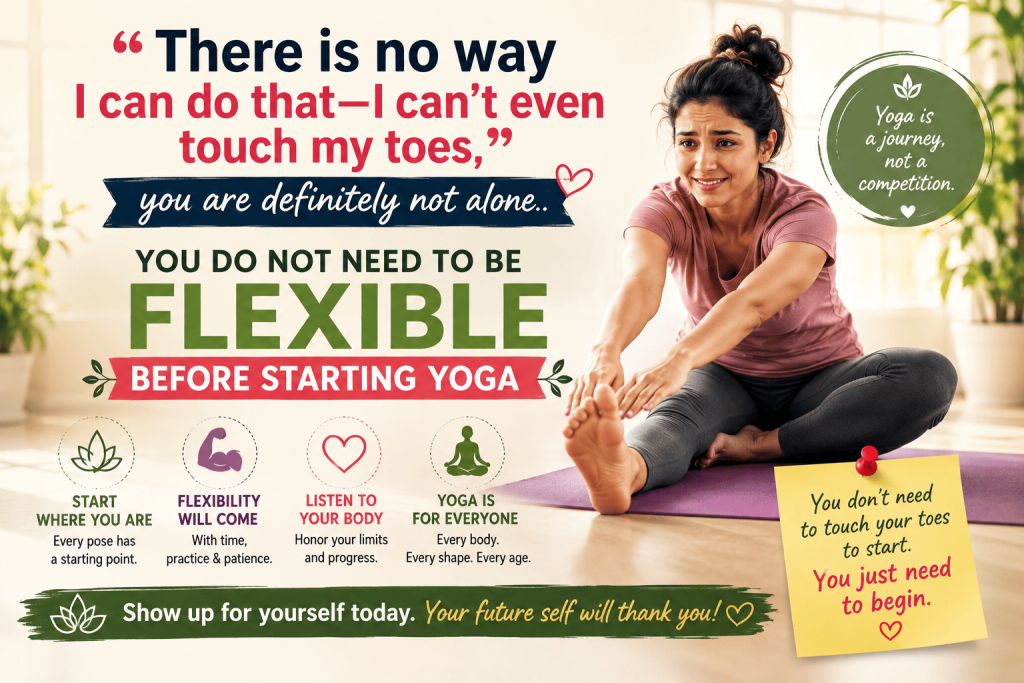
If you have ever looked at a yoga photo and thought, “There is no way I can do that—I can’t even touch my toes,” you are definitely not alone. A lot of people assume that yoga is only for naturally flexible people who can fold themselves into impressive shapes, sit comfortably in difficult positions, or bring their feet behind their heads. But here is the truth: you do not need to be flexible before starting yoga. In fact, waiting until you become flexible before doing yoga is a little like waiting to become fit before exercising. Yoga is not an entrance exam where flexibility is the qualifying requirement; it is a practice that can gradually help you develop mobility, body awareness, strength, balance and greater comfort in movement. Current beginner-focused guidance also emphasizes that you can start yoga without already being flexible or fit.
If your body feels stiff when you wake up, your hamstrings feel tight when you bend forward, or your hips and shoulders don’t move as freely as you would like, that does not mean yoga isn’t for you. It simply tells you where your body is starting from. Think of your first yoga session as the starting point on a map, not the destination. You might not reach your toes on day one, and that is completely fine. With appropriate movements, breathing, modifications and consistency, your body can gradually become more comfortable with different ranges of movement. Research supports this general idea: a systematic review of yoga interventions found potential improvements in spinal flexibility and mobility, while broader stretching research has found meaningful flexibility gains, including among people who started with lower flexibility.
You Don’t Need Flexibility to Start Yoga
One of the biggest misconceptions surrounding yoga for beginners is that you have to “prepare” your body before joining a class. You don’t. You don’t need to spend three months stretching at home, learn how to touch your toes, lose weight, buy expensive yoga clothes, or become athletic first. You simply need a willingness to begin at an appropriate level. A good beginner yoga class should meet you where your body is today rather than expecting you to imitate someone who has been practising for years. This is particularly important because every person’s anatomy, previous physical activity, age, lifestyle and movement habits are different. Two people can perform the same yoga pose and have completely different ranges of motion—and neither person is necessarily doing anything wrong.
Yoga Is the Journey, Not the Flexibility Test
Imagine someone learning to play the piano. Would you tell them they need to play a complicated concert piece before taking their first lesson? Of course not. Yoga works in much the same way. Your first objective isn’t to achieve the deepest version of a pose; it is to learn how to move, breathe and understand what your body is communicating. When you approach yoga this way, flexibility becomes one possible outcome of practice, rather than the price of admission. A 2025 study involving 150 healthy young adults found significant improvements in hamstring flexibility after four weeks of a programme incorporating loosening exercises and Paschimottanasana, demonstrating that flexibility can change through structured practice rather than being something you must already possess.
Why Do Beginners Feel Too Stiff for Yoga?
Modern lifestyles can make stiffness feel almost normal. Think about how many hours you might spend sitting at a desk, driving, working on a laptop, scrolling on your phone or watching television. Your body adapts to the positions you repeatedly use, so it is hardly surprising that certain movements may feel restricted when you suddenly ask your body to move differently. Tight-feeling hamstrings, hips, shoulders and the upper back are especially common concerns among people beginning a movement practice. But feeling stiff doesn’t mean your body is incapable of change. It simply means you should begin intelligently rather than aggressively.
Tight Hamstrings, Hips and Shoulders Are Common
A beginner who cannot touch their toes may immediately assume that their hamstrings are “bad” or that they are terrible at yoga. That conclusion is far too simplistic. Flexibility and range of motion involve several factors, including joint structure, muscle and tendon characteristics, nervous-system responses, previous activity and how comfortable you are at the edge of a movement. Current research even emphasizes that range of motion and flexibility are related concepts but should not simply be treated as identical measurements.
This is why forcing yourself deeper into a pose isn’t automatically the answer. If your forward fold stops several inches above your feet, stay there. You can bend your knees, use blocks, reduce the depth or choose another variation. The goal is to create a useful stimulus without turning your practice into a battle against your own body.
Does Yoga Actually Improve Flexibility?
Yes, yoga can help improve flexibility and mobility, particularly when it is practised consistently and appropriately. But it is important to avoid making unrealistic promises such as “do this pose for seven days and become completely flexible.” Your body doesn’t work like a software update that installs overnight. Improvements tend to develop through repeated exposure to movement, strength development, improved control, greater tolerance of stretching sensations and better awareness of how your body moves. A systematic review examining yoga’s effects on spinal and shoulder mobility found evidence suggesting yoga can improve spinal flexibility and mobility across populations including healthy adults, older adults and people with chronic low-back pain.
Flexibility, Mobility and Range of Motion Are Different
This distinction matters if you want to practise intelligently. Flexibility generally refers to how much movement a muscle or group of tissues can allow, while mobility is a broader concept involving your ability to actively control movement through a range of motion. You don’t simply want to become a human rubber band; you want to feel more capable and comfortable when bending, reaching, rotating, squatting or moving through daily activities. Recent research on stretching also found that chronic static stretching has a large positive effect on flexibility and that people with poorer baseline flexibility can experience larger improvements.
That is encouraging if you’re starting from a stiff place. You don’t need to compare yourself with the most flexible person in the room. Your useful benchmark is your own starting point. If your shoulders move more comfortably after several weeks, your forward fold feels less restricted, or getting up from the floor becomes easier, those are meaningful signs of progress even if your toes are still nowhere near your fingertips.
Best Yoga Poses for Beginners Who Aren’t Flexible
When you’re new to yoga, the best poses aren’t necessarily the most impressive ones. You want movements that allow you to explore your range without forcing your body into positions it isn’t prepared for. Depending on your individual needs, a beginner sequence might include gentle standing movements, Cat-Cow, supported Child’s Pose, a comfortable seated position, gentle twists, low-intensity hip movements and modified forward folds. Props can be extremely useful because they bring the floor closer to you instead of making you struggle to reach it. This is one reason a beginner-friendly yoga class can be more useful than simply copying advanced poses from social media.
Use Modifications Instead of Forcing the Pose
Suppose you are performing a standing forward fold and your fingertips are nowhere near the floor. Instead of rounding aggressively through your spine or pulling yourself downward, place your hands on blocks, bend your knees slightly and allow your torso to move within a comfortable range. That’s not “cheating.” That is intelligent practice. Current beginner guidance specifically warns against forcing flexibility, locking joints, bouncing into stretches and confusing discomfort with progress.
The same principle applies to virtually every pose. Your version of the pose is allowed to look different from someone else’s. Yoga blocks, straps, cushions, blankets and wall support aren’t signs that you are weak; they are tools that help you work with your current ability. An experienced yoga teacher can also show you how to modify positions rather than simply telling you to “stretch harder.”
How Often Should You Practise Yoga to Become More Flexible?
Consistency usually matters more than trying to destroy your muscles in one enormous weekend session. If you’re beginning, a manageable schedule that you can actually maintain is far more useful than an ambitious plan that lasts five days and then disappears. Recent beginner guidance from Vogue India notes that even 10–15 minutes of mindful yoga several times a week can support mobility, posture and stiffness over time, while longer sessions can provide space for warm-up movements, asanas, breathing and relaxation.
You can think of flexibility like watering a plant. Pouring an entire bucket onto it once a month isn’t necessarily better than giving it appropriate care regularly. Your body responds to repeated, sensible practice. Start with movements you can perform comfortably, pay attention to your breathing and gradually explore a little more range as your body becomes accustomed to the practice. If you’re searching for yoga at home, yoga for flexibility, yoga stretches, or morning yoga for beginners, focus less on chasing the perfect routine and more on finding a routine you can repeat.
Can a Yoga Teacher Help If You’re Very Stiff?
Absolutely—and this is where personalised instruction can make a major difference. When you’re practising alone, it can be difficult to know whether a pose feels challenging because your body is appropriately working or because you’re compensating somewhere else. A certified yoga teacher can observe your alignment, explain modifications, suggest props and help you understand the difference between productive effort and excessive strain. Instead of forcing every student into the same shape, a skilled instructor can offer variations that suit different bodies.
This is particularly valuable for someone who is nervous about joining their first class. You don’t have to walk into a yoga studio pretending you already know everything. Tell the teacher you’re a beginner and that flexibility is a concern. A good teacher should be more interested in helping you develop a sustainable practice than in making you perform impressive poses. Research on older adults, for example, has found that yoga can improve physical outcomes including flexibility, balance and muscle strength, reinforcing that yoga isn’t exclusively a young person’s activity.
Finding the Right Yoga Class Near You
If your biggest concern is, “Will everyone else be flexible except me?”, choose a class where beginners are genuinely welcome. When searching online, phrases such as “yoga class near you,” “yoga class near me,” “yoga class in Kolkata,” “yoga studio,” and “yoga for beginners” reflect the kind of local and beginner-focused search intent people commonly use. Current keyword research also shows substantial interest around terms such as yoga for beginners, yoga poses, yoga studio, yoga stretches, yoga for flexibility, and yoga near me.
For someone around East Kolkata, searches such as “yoga class in Kankurgachi,” “yoga class near Manicktala,” and “yoga class near Ultadanga” can be more useful than searching for a generic class hundreds of kilometres away. Local classes also give you the opportunity to learn directly from an instructor and build consistency through a regular schedule.
Yoga With Sandy for Beginner-Friendly Practice
If you’re looking for a supportive starting point, Yoga With Sandy can position its classes around exactly this concern: you don’t have to become flexible before joining. The message is simple—start where you are, practise safely, and let your body gradually develop greater mobility and confidence. Whether someone is completely new to yoga, returning after years away, or simply feels stiff from sitting and working all day, the emphasis should be on appropriate progression rather than comparison.
For people searching for a yoga class in Kankurgachi, yoga class in Kolkata, yoga class near Manicktala, or yoga class near Ultadanga, choosing an experienced instructor can remove much of the uncertainty that beginners feel. The right teacher won’t make you feel embarrassed because you can’t touch your toes; they will help you understand what your body can do today and how you can progress tomorrow. That’s the real value of working with a certified yoga teacher or experienced yoga teacher—you aren’t simply following poses; you’re learning how to practise them intelligently.
Conclusion
So, can you do yoga if you’re not flexible? Absolutely. You don’t need to touch your toes, perform a perfect forward fold or resemble an Instagram yoga model before your first class. Yoga can be part of the process through which you gradually develop flexibility, mobility, strength, balance, body awareness and confidence. Current research supports the potential of yoga and stretching-based practices to improve flexibility and mobility, while recent beginner guidance reinforces that starting ability should not be a barrier to beginning yoga.
The most important shift is changing the question from “Am I flexible enough for yoga?” to “What kind of yoga practice is appropriate for my body right now?” Once you make that shift, the pressure starts to disappear. You can use blocks, bend your knees, reduce the depth of a pose, practise near a wall and take breaks whenever necessary. Your body doesn’t need to impress anyone; it needs time, consistency and sensible guidance. If you have been searching for yoga for beginners, yoga for flexibility, yoga class near you, yoga class in Kankurgachi, or yoga class in Kolkata, don’t wait until you’re flexible enough to begin. Starting yoga is how the journey begins.
Frequently Asked Questions
1. Can I start yoga if I cannot touch my toes?
Yes. Not being able to touch your toes is not a reason to avoid yoga. You can practise modified forward folds using bent knees, blocks or other supports while gradually working on comfortable mobility.
2. How long does it take to become flexible with yoga?
There is no universal timeline because flexibility changes depend on your starting point, consistency, movement habits and individual anatomy. Research shows that flexibility can improve with regular stretching and yoga-based practice, but the rate of change varies between individuals.
3. What is the best yoga for completely inflexible beginners?
Start with a beginner-level yoga class that emphasizes gentle mobility, controlled movement, breathing, alignment and modifications. Avoid jumping immediately into advanced sequences simply because they look impressive online.
4. Should I stretch before doing yoga?
A suitable warm-up can help prepare your body for movement, but you don’t need to perform aggressive stretching before class. Gentle movements that gradually take your joints through comfortable ranges are generally a better starting point than forcing deep stretches.
5. Can an experienced yoga teacher help me improve flexibility?
Yes. An experienced yoga teacher can help you modify poses, use props correctly, understand alignment and progress gradually. If you’re completely new or particularly concerned about stiffness, personalised guidance can make your practice more comfortable and easier to understand.
