Have you ever opened YouTube, searched for a yoga workout, rolled out your mat, followed the instructor for 30 minutes, and then wondered, “Am I actually doing this correctly?” That is the biggest difference between watching yoga and learning yoga. YouTube yoga is undeniably convenient. You can practice at 6 AM, 11 PM, during a lunch break, or whenever you suddenly feel motivated. You do not need to travel, book a class, or adjust your schedule around a yoga studio. But convenience and personal instruction are not the same thing. When you follow a recorded video, the instructor cannot see whether your knee is collapsing inward, whether your shoulders are unnecessarily tense, whether you are holding your breath, or whether you are pushing beyond what your body can comfortably handle. A live online yoga class, on the other hand, creates a two-way learning environment. You are not simply watching someone demonstrate a pose; you are participating while a teacher observes, explains, responds, and adapts the session. Current research supports the value of online yoga while also highlighting a major limitation: participants can miss individualized guidance and feedback when interaction is weak. That is why the question is not really online yoga vs YouTube yoga. The better question is: do you want to simply follow a video, or do you want to actually learn and develop your yoga practice? For many beginners, working professionals, parents, and people with busy schedules, the answer becomes obvious once they experience the difference between pressing play and having a real teacher present.
YouTube Yoga Is Convenient, But Is It Really Personal?
YouTube has changed the way people discover yoga. You can find beginner yoga, morning yoga, flexibility sessions, meditation, power yoga, Ashtanga-inspired practices, yoga for stress, and hundreds of other formats within seconds. There is enormous value in that accessibility, especially if you are curious about yoga and want to understand what it feels like before joining a class. The problem begins when convenience becomes the entire learning system. A recorded instructor has already decided the sequence, pace, modifications, and intensity before you even step onto your mat. Your body, however, is not a prerecorded video. You might wake up feeling stiff one day, energetic the next, or experience discomfort in a particular movement that the video does not address. YouTube cannot look at your posture and say, “Move your foot slightly forward,” or “Do not go deeper into that pose today.” A live teacher can. That distinction becomes especially important when you are learning foundational movements because small technical habits can become difficult to change once they are repeated again and again. Research on online yoga has similarly identified limited personalized guidance, lack of individual feedback, and safety concerns as recurring barriers for some participants. So, yes, YouTube can be a fantastic library, but a library cannot replace a teacher who knows what you are doing. Think of it like learning to drive by watching driving videos. You can learn the theory, recognize the controls, and understand the basic movements, but someone beside you who can immediately notice your mistake changes the learning experience completely.
The Problem With Practising Without Feedback
The human body gives you signals constantly, but beginners do not always know how to interpret them. Is that stretching sensation normal? Is the pressure in your knee a sign to modify the pose? Should your back be rounded or neutral? Are you engaging your core correctly? When you are alone with a video, you may simply imitate the shape you see on the screen because the instructor looks confident and the sequence keeps moving. That can create a dangerous assumption: if the pose looks right, it must be right for me. Yoga does not work that way. Alignment is not merely about creating a beautiful shape; it is about understanding how your individual body moves, where your limitations are, and how to practice within an appropriate range. A 2025 study examining communication in live-streamed versus in-person group yoga found that individualized feedback was significantly reduced in live-streamed classes compared with in-person sessions, showing that simply calling something “live” does not automatically guarantee personalization. This is an important point for anyone comparing online options. A good live class should deliberately create opportunities for students to ask questions, show their practice, receive verbal corrections, and communicate discomfort. In other words, live yoga works best when the teacher actually teaches rather than simply broadcasts. That is where a certified yoga teacher can make a meaningful difference. Instead of asking you to copy a pose perfectly, the teacher can help you understand the purpose behind the movement and give you a practical adjustment that makes sense for your body.
What Makes a Live Online Yoga Class Different?
A live online yoga class combines the convenience of home practice with something YouTube cannot fully reproduce: human interaction in real time. You can remain in your own home, avoid traffic, skip the commute, and still enter a scheduled class where a real instructor is teaching you and other students at that exact moment. This format has become particularly attractive to people who want structured practice without travelling to a physical location. Recent reporting on live online yoga also emphasizes convenience, scheduled sessions, instructor guidance, and accountability as important parts of the format. The beauty of this model is that your home becomes your practice space without turning your practice into a completely isolated activity. You can ask a question when something feels confusing, mention when a movement is uncomfortable, and receive guidance while you are still in the pose. A teacher can also change the pace of the class depending on what they observe. Maybe everyone needs another minute in a warm-up. Maybe a particular pose needs a simpler variation. Maybe beginners need more explanation before moving forward. That flexibility is difficult to achieve with a fixed recording. A live class feels less like watching television and more like having a teacher enter your practice space. You still receive the accessibility of online learning, but the learning itself becomes interactive. For someone searching for an online yoga class near you, that distinction can be far more valuable than simply finding the cheapest or most popular video.
Real-Time Corrections and Personal Guidance
Imagine you are practising downward-facing dog and your heels are lifting, your shoulders are tense, and you are putting too much pressure into your wrists. A YouTube instructor can demonstrate the ideal position, but they cannot see your version of it. In a live class, an experienced instructor may notice the pattern and explain how to distribute your weight, soften your knees, lengthen your spine, or modify the posture. That single correction can teach you more than watching ten additional videos. The same principle applies to breathing, transitions, balance, seated postures, twists, and strength-based movements. Feedback closes the learning loop: you attempt something, receive information, adjust your technique, and try again. That is how skills develop. Current research into remote yoga supports the idea that live remote delivery can communicate many essential elements of yoga, while also suggesting that instructors should deliberately provide individualized verbal cues and opportunities for interaction. This is why choosing an experienced yoga teacher matters even when your class is online. The technology delivers the class, but the instructor delivers the teaching. A webcam and microphone are only tools; observation, communication, experience, and judgment are what make those tools useful. If you are practising at home because travelling to a yoga class in Kolkata is inconvenient, you should not have to sacrifice guidance simply because you chose an online format. The strongest live classes bring the teacher to you rather than leaving you alone with a screen.
Ask Questions Instead of Guessing
One of the simplest advantages of a live class is also one of the most overlooked: you can ask why. Maybe you want to know why your hamstrings feel tight during a forward fold. Perhaps your wrist hurts during a weight-bearing posture. Maybe you are unsure whether you should bend your knees or keep them straight. With a recorded video, you generally have three options: guess, pause the video and search for another explanation, or stop practising. In a live class, you can ask the instructor directly. That immediate exchange can turn confusion into understanding within seconds. It also helps you become an active participant rather than a passive follower. Over time, you begin recognizing your own movement patterns and understanding when to modify a pose instead of blindly copying it. That is particularly useful for beginners who may feel overwhelmed by yoga terminology. A teacher can translate technical instructions into simple language and demonstrate an alternative when necessary. This personal conversation is also one reason live online yoga can feel surprisingly different from watching YouTube even though both happen through a screen. The screen itself is not the important part. The relationship behind the screen is. You are not interacting with a video file; you are interacting with a person who can respond to you.
Live Yoga Builds Accountability and Consistency
Knowing what to do is not the same as actually doing it. This is where YouTube often loses its advantage. You may save ten yoga videos, create a playlist called “Morning Yoga,” buy a new mat, and tell yourself you will practice every day. Then Monday becomes Tuesday, Tuesday becomes next week, and the mat quietly becomes part of the furniture. There is nothing wrong with recorded yoga, but it places almost all the responsibility on you. A scheduled live class changes that psychology. You know the class starts at a particular time. You know your instructor will be there. You may recognize other students. You may even feel that someone will notice if you repeatedly disappear. That small sense of commitment can be surprisingly powerful. A recent large international study of online yoga found that live-streamed classes could support accountability, social connectedness, and motivation, while lack of motivation was reported as a barrier for some people practising with less structure. This matters because consistency is what turns yoga from an occasional activity into a practice. You do not need to feel motivated every morning. Sometimes you simply need a reason to show up. Live classes provide that external structure while still allowing you to practise from home. It is similar to having a walking partner: you might be capable of walking alone, but knowing someone is waiting for you makes it much easier to put on your shoes.
Why Showing Up Matters More Than Motivation
Motivation is unpredictable. Some days you wake up excited to exercise; other days your workload, family responsibilities, traffic, fatigue, or simple laziness wins the argument. A live class creates a commitment that does not depend entirely on how you feel at that moment. Once you join regularly, the scheduled time becomes part of your routine, almost like brushing your teeth or attending a meeting. That consistency is especially useful for working professionals and parents who want to practise but struggle to create uninterrupted time. You do not need to travel across Kolkata, search for parking, or spend an hour commuting before your practice even begins. You simply prepare your mat, open the session, and show up. Research on online yoga has found convenience and accessibility to be major benefits, while also indicating that social connection and instructor familiarity can strengthen engagement. That is why a live class can occupy a useful middle ground between a physical yoga studio and a completely self-directed YouTube workout. You retain the comfort of home while gaining a scheduled learning environment. For many people, that is the practical formula that finally makes regular yoga possible. The goal is not to become perfectly disciplined overnight. The goal is to make practice easy enough, structured enough, and meaningful enough that you keep returning to your mat.
Live Online Yoga vs YouTube Yoga: A Practical Comparison
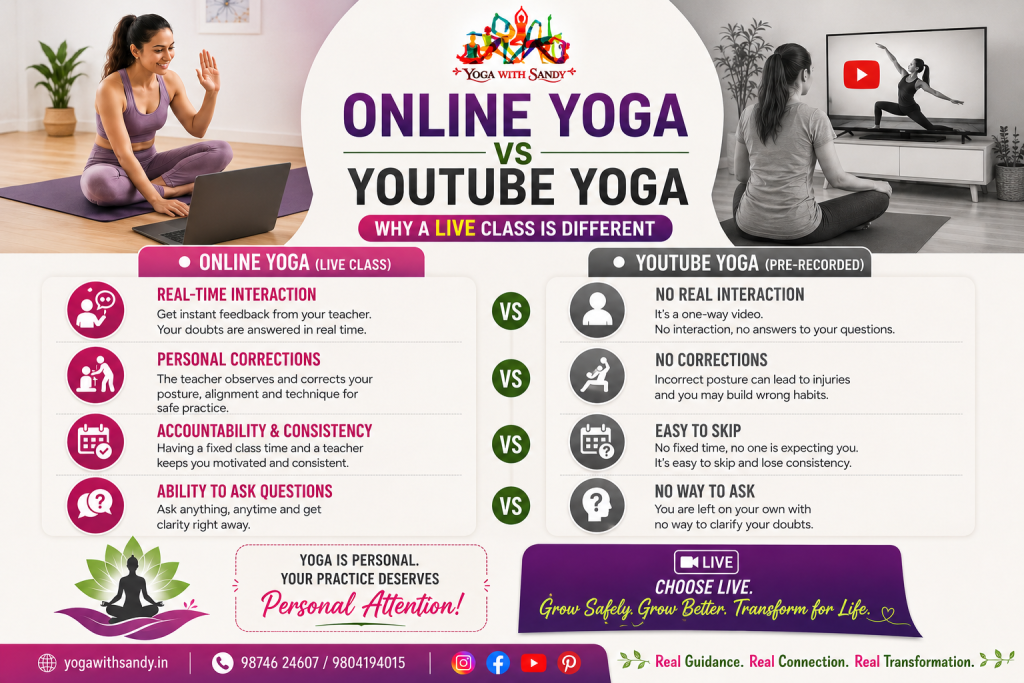
| Feature | YouTube Yoga | Live Online Yoga |
|---|---|---|
| Schedule | Completely flexible | Fixed or scheduled sessions |
| Instructor interaction | Usually none | Real-time interaction |
| Personal corrections | Limited to none | Possible during class |
| Questions | Requires separate research | Ask the teacher immediately |
| Accountability | Mostly self-driven | Instructor and group structure |
| Pace | Predetermined | Can be adapted by the instructor |
| Community | Limited | Live group connection |
| Beginner support | Depends on video | Direct guidance available |
| Convenience | Excellent | Excellent |
| Personalization | Low | Higher when class size is manageable |
The comparison makes one thing clear: both formats have a place, but they serve different purposes. YouTube is excellent when you already understand your body, know how to modify movements, and simply want a convenient practice library. It is also useful for experimenting with different styles or fitting a short session into an unpredictable day. Live online yoga becomes more valuable when you want instruction, structure, accountability, and interaction. A 2026 study involving more than a thousand practitioners and teachers found that online yoga offered substantial benefits but also identified personalized guidance as an important limitation, particularly for students who need more support. There is also evidence that asynchronous online yoga can be feasible and beneficial: a recent pilot randomized study of 40 adults with moderate-to-high stress found good acceptability and reported improvements in perceived stress, sleep disturbance, mindfulness, and mood. So this is not an argument that YouTube yoga is “bad.” It is an argument for choosing the format according to your goal. If your goal is entertainment, exploration, or occasional movement, a video may be enough. If your goal is learning yoga properly and developing a consistent practice, having a teacher involved can make the journey much more structured.
Which Option Is Better for Beginners?
For a complete beginner, live instruction generally offers a stronger learning environment because you do not yet have the experience to recognize every technical mistake yourself. You may not know whether your posture is appropriate, whether you should modify a movement, or how intensely you should practise. A beginner can easily confuse discomfort with progress or flexibility with correct alignment. Having an instructor explain the fundamentals and watch how you move can reduce that uncertainty. This does not mean every live online class is automatically suitable for beginners. Class size, teacher experience, communication quality, camera setup, and the instructor’s willingness to give individual feedback all matter. Research specifically examining online yoga has highlighted concerns around safety and personalized guidance, especially among less experienced practitioners. Therefore, if you are searching for a yoga class near you, do not judge a class only by whether it is online or offline. Ask whether the teacher explains modifications, welcomes questions, understands different experience levels, and creates a supportive environment. If you live around Kankurgachi, Manicktala, Ultadanga, or another part of Kolkata, you may have plenty of local options, but a good online class can remove geographical limitations entirely. You can learn from home while still receiving real instruction. That combination can be especially useful if you are nervous about entering a physical studio for the first time.
Why Live Online Yoga Can Be Better Than Travelling to a Yoga Studio
A physical yoga studio has obvious benefits: you get a dedicated environment, face-to-face interaction, and the atmosphere of practising with others in the same room. But getting there takes time. For someone living or working in Kolkata, a class that technically lasts 60 minutes can consume much more of the day once travel, preparation, traffic, and return time are included. That is where live online yoga becomes incredibly practical. Your living room can become your yoga space in minutes. You can finish the session, drink some water, and return to work or family responsibilities without another commute. This accessibility is one reason online yoga continues to attract people who might otherwise struggle to participate consistently. Current online yoga research identifies convenience and accessibility among the strongest perceived benefits of the format. A live online class also allows you to maintain the human element that a recorded video lacks. You still hear your teacher’s voice, interact with classmates, ask questions, and receive guidance. In that sense, the format removes one major disadvantage of studio classes-travel-without necessarily removing the relationship that makes a class meaningful. If you have searched for yoga class near Manicktala, yoga class near Ultadanga, or yoga class in Kankurgachi, you should not limit yourself to a physical address. The better question may be: where can I receive high-quality instruction consistently? Sometimes the best yoga class near you is the one you can join without leaving your home.
Finding the Right Yoga Class Near You in Kolkata
When people search “yoga class near you”, they often focus first on distance, price, and ratings. Those factors matter, but they do not tell the entire story. A class five minutes away is not necessarily better than a live class you can join from your home every morning. Likewise, a highly rated instructor may not teach in a way that suits your experience level or goals. Current Kolkata listings show a broad market of yoga instructors, studios, and online/offline classes, which means students have more choices than ever. The challenge is choosing intelligently. Look for a certified yoga teacher, ask about teaching experience, check whether beginners are welcome, understand the class format, and find out whether the teacher offers modifications. If you are specifically looking for a yoga class in Kolkata, consider whether you want an in-person class close to home or the flexibility of a live online session. Someone living around Kankurgachi may naturally search for yoga class in Kankurgachi, while someone near Ultadanga may search for yoga class near Ultadanga. These local searches are useful, but your final decision should be based on teaching quality rather than the keyword on the Google result. Yoga is a personal practice. The right teacher should make you feel guided, not judged; challenged, not pressured; and supported, not forgotten in a large group.
Why Choose Yoga With Sandy for Live Online Yoga?
If you are looking for a way to combine home-based convenience with personal instruction, Yoga With Sandy is designed around that exact idea. Instead of asking you to press play and copy a sequence without feedback, the focus is on creating an interactive experience where students can learn directly from a teacher. That matters whether you are completely new to yoga or already have some experience and want to improve your technique. As a certified yoga teacher and experienced yoga teacher, Sandy can guide students through yoga practices while adapting instructions to different levels and needs. The advantage of live online classes is that you do not have to choose between convenience and connection. You can practise from home while still being part of a scheduled class. For someone searching for yoga classes in Kolkata, yoga classes in Kankurgachi, or an online option that removes travel completely, this can be a practical solution. You can also think of it as bringing the teacher to your mat rather than forcing yourself to travel to the teacher. The broader research is encouraging here: live virtual yoga has demonstrated feasibility and potential effectiveness, including in a randomized clinical trial where 140 adults with chronic low back pain participated in weekly live-streamed yoga classes and experienced sustained improvements in pain and back-related function. Of course, individual results vary and yoga should not be treated as a universal medical treatment, but the evidence reinforces an important point: online yoga can be more than a convenient substitute when it is delivered thoughtfully. The teacher, structure, communication, and consistency are what turn an online session into a genuine class.
Conclusion – Yoga Is More Than Pressing Play
YouTube made yoga incredibly accessible, and that is something worth appreciating. You can practise almost anywhere, explore different styles, and find a session that fits your schedule without spending anything. But accessibility does not automatically equal instruction. If you are serious about learning yoga, improving your technique, staying accountable, and understanding what your body is doing, the presence of a real teacher can change the entire experience. Live online yoga combines the convenience of home practice with the human connection of a class, giving you an opportunity to ask questions, receive feedback, build a routine, and practise alongside other people. Research into online yoga consistently points toward convenience and accessibility as major strengths while identifying personalization, feedback, motivation, and connection as areas that require thoughtful delivery. That is why the real comparison is not simply online yoga versus YouTube yoga. It is guided practice versus self-guided practice. If you already know your body and simply want an occasional workout, YouTube may be perfectly suitable. But if you want someone to teach you, notice you, correct you, encourage you, and help you grow, live yoga offers something a recording cannot. Whether you are searching for Yoga With Sandy, a yoga class in Kankurgachi, a yoga class in Kolkata, a yoga class near Manicktala, a yoga class near Ultadanga, or simply a reliable yoga class near you, remember this: the most convenient class is useful, but the right teacher can make you consistent. And consistency is where the real transformation begins.
FAQs About Live Online Yoga and YouTube Yoga
1. Is live online yoga better than YouTube yoga for beginners?
For many beginners, yes, because a live class allows direct interaction with a teacher. You can ask questions, receive verbal corrections, understand modifications, and learn why a movement is performed instead of simply copying it. Research on online yoga has identified personalized guidance and safety as important concerns, particularly for less experienced practitioners. YouTube can still be useful for exploration, but live instruction generally provides a stronger learning structure.
2. Can I get proper yoga guidance through an online class?
Yes, provided the class is genuinely interactive and the teacher actively observes and communicates with students. A live online class cannot provide every benefit of being physically present in a studio, but instructors can still offer verbal alignment cues, modifications, pacing changes, and individual feedback. Research suggests that live remote yoga can preserve many essential components of yoga while encouraging instructors to deliberately increase individualized feedback.
3. Do I need to travel to a yoga studio for effective yoga practice?
No. Travelling to a yoga studio is one option, not a requirement. Live online yoga allows you to practise from home while maintaining a scheduled class and interaction with an instructor. This can be particularly useful for working professionals, parents, seniors, and anyone whose schedule or location makes regular travel difficult.
4. How do I choose a good live online yoga teacher?
Look for a certified yoga teacher with meaningful teaching experience, clear communication, beginner-friendly instruction, and a willingness to provide individual feedback. Before joining regularly, ask whether the teacher offers modifications and whether students can ask questions during the class. The quality of the interaction matters more than whether the class simply has the word “live” in its description.
5. Is Yoga With Sandy suitable if I live outside Kankurgachi or Kolkata?
Yes. One of the biggest advantages of a live online format is that you do not have to live immediately beside the instructor. Students searching for yoga classes in Kolkata, yoga classes in Kankurgachi, or a yoga class near you can choose online instruction when travelling to a physical location is inconvenient. You can practise from home while still receiving live guidance from an experienced yoga teacher.
