“Yoga is not about touching your toes. It is about what you learn on the way down.”
The modern world runs on speed, distraction, and overstimulation. Most people wake up tired, scroll endlessly through their phones, rush through meals, and carry stress like an invisible backpack throughout the day. In the middle of this chaos, Ashtanga Yoga offers something rare – structure, discipline, clarity, and inner transformation. It is not just another fitness trend. It is a complete system that trains the body, sharpens the mind, and strengthens emotional resilience.
Search trends in 2026 show growing global interest in keywords like “Ashtanga yoga benefits,” “daily yoga sequence,” “morning yoga routine,” “mind-body wellness,” “yoga for focus,” “stress relief yoga,” and “Ashtanga yoga for beginners.” Wellness researchers are increasingly studying yoga’s impact on mental health, nervous system regulation, flexibility, recovery, emotional balance, and productivity. According to recent research, yoga-based practices continue to show measurable benefits for anxiety reduction, stress management, and emotional wellbeing.
Unlike random workout routines that change every day, Ashtanga Yoga follows a structured sequence. Each pose prepares the body for the next one. Breath and movement synchronize together like music and rhythm. Over time, practitioners develop strength, mobility, discipline, concentration, and self-awareness. That is why many yoga practitioners describe Ashtanga not as exercise, but as a lifelong practice.
What Is Ashtanga Yoga?
Ashtanga Yoga is a dynamic and physically demanding style of yoga that combines movement, breath control, and concentration into a flowing sequence of postures. The word “Ashtanga” comes from Sanskrit, where “Ashta” means eight and “Anga” means limbs. These eight limbs form the foundation of classical yoga philosophy described by the sage Patanjali in the Yoga Sutras. This system goes far beyond physical exercise. It includes ethical principles, breath regulation, concentration, meditation, and spiritual awareness.
What makes Ashtanga unique is its fixed sequence structure. Every practitioner follows the same order of postures, allowing the body and mind to gradually evolve through repetition and discipline. Think of it like learning a musical instrument. A pianist practices scales repeatedly, not because repetition is boring, but because mastery comes through consistency. The same principle applies in Ashtanga Yoga. Repeating the sequence trains muscle memory, enhances body awareness, and develops mental focus.
The practice is deeply connected to synchronized breathing known as Ujjayi breath. Each movement follows inhalation or exhalation, creating a moving meditation. Over time, practitioners often notice that their racing thoughts begin to slow down. The practice becomes less about performance and more about presence. Many people initially start Ashtanga Yoga for physical fitness, but they stay because of the emotional balance and inner clarity it creates.
The growing popularity of structured wellness routines has also increased interest in Ashtanga worldwide. Online discussions and practitioner communities frequently highlight how consistent practice improves energy levels, emotional stability, and long-term discipline.
The Origin and Philosophy of Ashtanga
The modern form of Ashtanga Yoga was popularized by K. Pattabhi Jois in Mysore, India. His teaching system emphasized disciplined daily practice, synchronized breath, and progressive learning. Unlike casual yoga classes where poses change daily, Ashtanga follows a methodical progression. Students master one posture before moving to the next, creating a strong foundation for safe advancement.
At its core, Ashtanga is about transformation. The physical poses are only one layer of the practice. The deeper goal is purification – cleansing the body, calming the nervous system, and developing awareness. Imagine your mind as a muddy lake disturbed by constant thoughts and stress. Through steady practice, the water slowly settles, allowing clarity to emerge. This is one reason why experienced practitioners often describe yoga as mental training rather than just stretching.
The philosophy also emphasizes discipline. In today’s world of instant gratification, consistency itself becomes a form of inner growth. Showing up on the mat regularly teaches patience, humility, resilience, and self-observation. Some days the practice feels effortless, while other days the body feels heavy and distracted. Learning to continue without attachment to perfection becomes part of the journey.
Modern wellness experts increasingly recognize the value of these mind-body systems. The 2026 Global Wellness Institute described yoga as evolving into a “science-based system of self-regulation and preventive health.” This growing recognition reflects how ancient yogic wisdom is now intersecting with neuroscience, stress management research, and behavioral health studies.
Understanding the Ashtanga Yoga Sequence
The Ashtanga system is traditionally divided into three major series: Primary Series, Intermediate Series, and Advanced Series. Each level progressively challenges the body and mind while developing strength, flexibility, endurance, and concentration.
Primary Series
The Primary Series is called Yoga Chikitsa, which means yoga therapy. Its primary goal is detoxification and alignment. The sequence includes standing poses, seated forward folds, twists, balances, and finishing postures. This series builds flexibility in the hips, hamstrings, spine, and shoulders while strengthening the core and improving posture.
Many beginners are surprised by how physically intense the practice feels. Unlike passive stretching, Ashtanga continuously demands controlled movement and active engagement. The repetitive flow generates internal heat, encouraging sweating and circulation. Over time, practitioners often notice improved digestion, better posture, reduced stiffness, and increased stamina.
Intermediate Series
The Intermediate Series is known as Nadi Shodhana, meaning nerve purification. This sequence focuses more deeply on backbends, energy channels, and nervous system balance. The poses become increasingly demanding, requiring greater flexibility, balance, and breath control.
The transition from Primary to Intermediate teaches patience. Progress is gradual, and practitioners learn to respect their body’s limitations. This mindset helps reduce ego-driven practice and encourages sustainable growth.
Advanced Series
The Advanced Series emphasizes strength, deep flexibility, and advanced concentration. These sequences are physically demanding and usually practiced only after years of consistent training. The advanced postures challenge coordination, courage, balance, and mental steadiness simultaneously.
What makes Ashtanga fascinating is how every series builds upon the previous one. The sequence is not random. Each posture prepares the practitioner for the next stage physically and mentally. Many practitioners online describe this structured progression as one of the system’s greatest strengths.
Physical Health Benefits of Ashtanga Yoga
One of the biggest reasons people start Ashtanga Yoga is to improve physical health. The practice engages nearly every muscle group while simultaneously training endurance, flexibility, coordination, and breathing efficiency. Unlike isolated gym exercises, Ashtanga integrates the entire body into connected movement patterns.
Improves Flexibility and Mobility
Modern lifestyles create stiff hips, rounded shoulders, tight hamstrings, and poor posture. Hours of sitting weaken mobility and compress the spine. Ashtanga gradually counteracts these effects through repeated stretching and strengthening patterns. The flowing transitions help improve joint mobility while increasing blood flow to muscles and connective tissues.
Flexibility in Ashtanga is not forced. Over time, the body adapts naturally through consistent practice. Many practitioners initially struggle to touch their toes or maintain balance, but months later they notice smoother movement and reduced stiffness in daily life. Simple activities like climbing stairs, bending down, or sitting comfortably become easier.
Builds Core Strength and Endurance
Ashtanga Yoga heavily activates the core muscles. Transitions between poses require stability, balance, and controlled movement. Plank variations, arm balances, and standing sequences challenge abdominal strength continuously. This leads to improved posture, spinal support, and functional fitness.
The practice also develops cardiovascular endurance. Because the sequence flows continuously with synchronized breathing, heart rate remains elevated throughout practice. Many people underestimate how physically demanding yoga can be until they experience a full Ashtanga session.
Supports Heart Health and Blood Circulation
Recent research increasingly supports yoga’s role in stress reduction and nervous system balance. Since chronic stress affects blood pressure, inflammation, and heart health, practices that calm the nervous system may indirectly support cardiovascular wellness.
The controlled breathing in Ashtanga also improves oxygen efficiency. Deep rhythmic breathing enhances circulation and encourages relaxation responses in the body. It is like switching the body from “survival mode” into “repair mode.”
Mental and Emotional Benefits
Many people arrive at yoga seeking physical transformation but eventually realize the mental benefits are even more powerful. The structure of Ashtanga creates a unique psychological effect because it demands presence and concentration.
Reduces Stress and Anxiety
Modern stress keeps the nervous system stuck in fight-or-flight mode. Constant notifications, deadlines, and emotional overload make it difficult for the brain to rest. Ashtanga interrupts this cycle by combining movement with controlled breathing. The repetitive rhythm acts almost like meditation in motion.
Recent studies continue to show yoga’s effectiveness for stress management, emotional regulation, and anxiety reduction. Research published in 2026 found that yoga interventions significantly reduced stress-related symptoms and improved emotional wellbeing.
Practitioners often describe feeling calmer after practice, even if they were mentally overwhelmed beforehand. The breath becomes an anchor. Instead of obsessing over worries, the mind focuses on movement, alignment, and rhythm.
Improves Focus and Mental Clarity
Distraction has become the default mental state for many people. Ashtanga trains concentration by forcing attention into the present moment. Each posture requires awareness of breathing, gaze direction, body alignment, and movement timing simultaneously.
This focused awareness often carries into everyday life. Practitioners report improved productivity, sharper concentration, and better emotional control outside the yoga studio. The mental discipline developed on the mat slowly influences work, relationships, and decision-making.
Enhances Emotional Stability
Yoga also teaches emotional observation. During difficult poses, frustration, impatience, insecurity, or self-judgment often arise. Instead of escaping discomfort, practitioners learn to breathe through it calmly. This skill becomes incredibly valuable in daily life.
Think of emotional resilience like strengthening a muscle. Every challenging posture becomes an opportunity to practice patience and calmness under pressure. Over time, emotional reactions become less impulsive and more balanced.
How Ashtanga Yoga Supports Inner Growth
The deepest benefits of Ashtanga Yoga are often invisible from the outside. While physical flexibility is obvious, inner growth develops quietly through discipline, awareness, and consistency.
Discipline and Self-Awareness
Daily practice teaches accountability. Nobody can do the practice for you. Every session becomes a conversation between your body, mind, and breath. Some days feel strong, while others feel frustrating. Learning to show up regardless of mood develops emotional maturity and mental resilience.
The fixed sequence also creates self-awareness because progress becomes measurable. You begin noticing how sleep, stress, nutrition, emotions, and habits affect your practice. Yoga becomes like a mirror reflecting your internal state.
Breath Control and Mindfulness
Breath is central to Ashtanga Yoga. When breathing becomes shallow or rushed, the body tightens and the mind loses focus. Controlled breathing teaches calmness under challenge. This has powerful applications outside yoga as well.
Stressful conversations, work pressure, and emotional situations become easier to manage when you learn how to regulate breathing consciously. It is similar to learning how to stabilize a ship during rough waves. The external storm may continue, but your internal balance becomes steadier.
Research into yoga and nervous system regulation continues expanding rapidly. Scientists increasingly recognize how breathing techniques influence stress hormones, heart rate variability, emotional regulation, and cognitive performance.
Scientific Research Behind Yoga Benefits
Modern science is now validating many traditional yogic principles that practitioners have experienced for centuries. Researchers continue studying yoga’s impact on stress reduction, emotional health, nervous system balance, and recovery support.
A 2026 review highlighted yoga’s effectiveness in reducing anxiety and depressive symptoms while improving emotional regulation. Another large analysis found exercise and mind-body practices to be highly effective for mental wellness across diverse populations.
Researchers are also exploring yoga’s role in addiction recovery, chronic stress management, and nervous system regulation. A collaborative study involving Indian and Harvard researchers found yoga significantly reduced opioid withdrawal recovery time while improving sleep and lowering anxiety.
The science behind yoga increasingly points toward one major concept: mind and body cannot be separated. Physical movement influences emotional states, breathing affects nervous system activity, and mental focus impacts physical health. Ashtanga Yoga integrates all these elements simultaneously.
| Benefit | How Ashtanga Helps |
|---|---|
| Flexibility | Repetitive stretching improves joint mobility |
| Strength | Bodyweight transitions develop muscle endurance |
| Mental Focus | Breath synchronization improves concentration |
| Stress Relief | Controlled breathing calms the nervous system |
| Posture | Core engagement supports spinal alignment |
| Emotional Balance | Mindfulness reduces reactive thinking |
Beginner Tips for Starting Ashtanga Yoga
Starting Ashtanga can feel intimidating because the sequence moves quickly and demands coordination. Beginners often compare themselves to advanced practitioners and become discouraged too early.
The most important principle is consistency over perfection. You do not need advanced flexibility to begin. Progress happens gradually through repetition. Think of the body like clay – steady pressure shapes it over time, not overnight.
One common beginner mistake is pushing too hard. Social media often glorifies extreme poses, but sustainable yoga practice requires patience. Injury usually happens when ego overrides awareness. Practicing with proper guidance and respecting limitations is essential.
Another key factor is breath awareness. Many beginners focus only on posture while ignoring breathing. In reality, breath is the foundation of the practice. Smooth breathing creates smoother movement and better concentration.
Practitioners in online yoga communities frequently emphasize the importance of modifications, recovery, and listening to the body for long-term sustainability.
Helpful beginner practices include:
- Practicing consistently rather than intensely
- Prioritizing breath over flexibility
- Warming up properly before deep stretches
- Avoiding comparison with others
- Taking rest when needed
- Learning from qualified instructors
Conclusion
Ashtanga Yoga is far more than a physical workout. It is a disciplined system that trains the body, sharpens concentration, regulates emotions, and supports personal transformation. The structured sequence creates stability in a world filled with distraction and inconsistency. Through breath, movement, and repetition, practitioners develop strength not only in muscles but also in mindset.
The benefits extend across physical health, mental clarity, emotional resilience, and inner awareness. Scientific research increasingly supports yoga’s role in stress reduction, nervous system balance, and emotional wellbeing. At the same time, centuries of traditional wisdom continue reminding us that true transformation happens through consistent practice.
Ashtanga Yoga does not promise instant perfection. It offers something more valuable – gradual evolution. One breath, one posture, and one practice at a time.
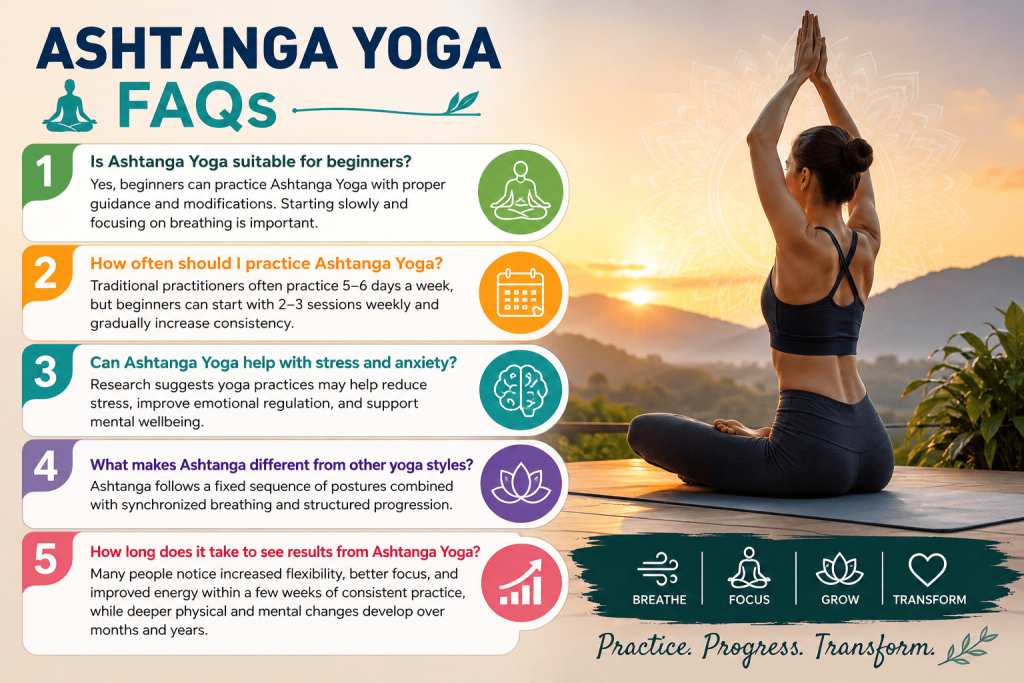
FAQs
1. Is Ashtanga Yoga suitable for beginners?
Yes, beginners can practice Ashtanga Yoga with proper guidance and modifications. Starting slowly and focusing on breathing is important.
2. How often should I practice Ashtanga Yoga?
Traditional practitioners often practice 5–6 days a week, but beginners can start with 2–3 sessions weekly and gradually increase consistency.
3. Can Ashtanga Yoga help with stress and anxiety?
Research suggests yoga practices may help reduce stress, improve emotional regulation, and support mental wellbeing.
4. What makes Ashtanga different from other yoga styles?
Ashtanga follows a fixed sequence of postures combined with synchronized breathing and structured progression.
5. How long does it take to see results from Ashtanga Yoga?
Many people notice increased flexibility, better focus, and improved energy within a few weeks of consistent practice, while deeper physical and mental changes develop over months and years.

A valuable contribution to the topic.
Thank You @MarkCollins