“Fitness is not about choosing one side. It is about building a body that is strong, flexible, balanced, and sustainable for life.”
The debate between yoga vs gym has exploded across social media, Google searches, fitness communities, and wellness platforms in 2026. Some people swear by yoga for complete transformation, while others believe lifting weights in the gym is the only way to build real fitness. If you have ever wondered whether yoga alone is enough or if combining yoga with gym workouts gives better results, you are asking one of the most searched fitness questions in India right now.
Search trends show rising interest in hybrid fitness routines that combine mobility, strength training, mindfulness, flexibility, fat loss, and recovery. According to recent wellness industry reports, the global yoga market crossed USD 127 billion in 2025 and is projected to grow rapidly through 2033. Around 300–350 million people worldwide now practice yoga in some form.
At the same time, strength training, muscle conditioning, and functional fitness are dominating gym culture. So where does that leave someone who wants overall health instead of blindly following trends? The truth is more nuanced than “yoga is enough” or “gym is better.”
This article breaks down the science, practical realities, expert opinions, and real-life fitness goals to help you understand what actually works.
Why This Debate Is Growing Rapidly in 2026
Fitness culture has changed dramatically over the last few years. Earlier, people mostly focused on aesthetics. Bigger muscles, six-pack abs, fast fat loss, and extreme transformations dominated fitness conversations. Today, people are beginning to realize that looking fit and actually being healthy are two very different things. That shift is one of the biggest reasons why the conversation around yoga and gym combination workouts is trending heavily in India and globally.
Recent reports show increasing demand for mind-body wellness, recovery-based workouts, mobility training, and sustainable fitness systems. Many gym-goers are now adding yoga to improve flexibility, posture, recovery, and mental clarity. At the same time, yoga practitioners are incorporating strength training because they want stronger muscles, better endurance, and improved metabolism. The old “either yoga or gym” mindset is slowly disappearing.
India is witnessing a particularly strong rise in yoga participation. Events connected to International Yoga Day continue breaking records, with lakhs of participants joining mass yoga sessions across the country. This growing awareness is also reflected in local searches for terms like “best yoga class in Kolkata,” “power yoga near me,” “yoga for weight loss,” “strength training with yoga,” and “yoga class in Kankurgachi.”
People are no longer looking for short-term transformation alone. They want energy, mobility, reduced stress, better sleep, emotional stability, and longevity. Imagine your body as a car. Gym workouts can make the engine powerful, but yoga helps with alignment, flexibility, balance, and maintenance. Without both, something eventually breaks down. That realization is why hybrid fitness is becoming the future.
What Does “Complete Fitness” Actually Mean?
Before deciding whether yoga alone is enough, we need to define what “fitness” really means. Most people think fitness simply means losing weight or getting toned. In reality, complete fitness includes several interconnected components that work together.
Strength
Strength is your body’s ability to generate force. It affects everything from carrying groceries to climbing stairs and preventing injuries as you age. Gym training, resistance exercises, and bodyweight strength work improve muscular strength significantly. Yoga also builds strength, especially in the core, shoulders, glutes, and stabilizer muscles, but it often lacks the progressive overload required for substantial muscle hypertrophy.
Flexibility and Mobility
This is where yoga shines brilliantly. Regular yoga practice improves joint mobility, muscle elasticity, balance, coordination, and posture. Many people who only lift weights become stiff over time because they ignore mobility work. Yoga helps maintain movement quality and prevents tightness.
Cardiovascular Endurance
Cardio fitness measures how efficiently your heart and lungs work. Some yoga styles like Vinyasa and Power Yoga elevate heart rate, but traditional gym cardio exercises such as running, rowing, cycling, and HIIT typically provide stronger cardiovascular conditioning.
Mental Wellness
One area where yoga dominates is mental fitness. Breathwork, mindfulness, meditation, nervous system regulation, and stress reduction are deeply embedded into yoga philosophy. Research and wellness experts increasingly highlight yoga’s role in reducing anxiety, improving sleep, and supporting emotional balance.
When you put all these pieces together, you realize that complete fitness is not one-dimensional. A person with huge muscles but chronic stress and poor flexibility is not fully fit. Similarly, someone extremely flexible but lacking muscular strength may also face physical limitations. Real wellness lives in balance.
Can Yoga Alone Keep You Fit?
The honest answer is yes – but it depends on your definition of fitness and your personal goals.
Yoga can absolutely help you stay healthy, active, lean, mobile, and mentally strong. Millions of people worldwide use yoga as their primary form of physical activity. Styles like Ashtanga Yoga, Power Yoga, Vinyasa Yoga, and Hot Yoga can improve muscular endurance, flexibility, coordination, and calorie expenditure. If practiced consistently, yoga can transform body composition, improve posture, strengthen the core, and increase body awareness dramatically.
Recent expert discussions suggest that yoga can noticeably improve flexibility within weeks while also enhancing stability and muscular endurance. This is especially important in modern lifestyles where prolonged sitting destroys posture and mobility. Office workers, students, entrepreneurs, and professionals often suffer from neck stiffness, lower back pain, weak hips, and stress-related fatigue. Yoga directly addresses many of these issues.
Another powerful advantage of yoga is sustainability. Unlike intense gym routines that many people quit after a few months, yoga tends to become a long-term lifestyle practice. It does not demand expensive equipment, complicated machines, or aggressive environments. This accessibility is one reason why yoga participation continues growing globally.
Still, yoga alone may not fully satisfy certain fitness goals. If your aim is significant muscle growth, maximal strength development, athletic explosiveness, or advanced body recomposition, traditional gym-based resistance training usually works more effectively. Yoga builds functional strength, but progressive resistance training creates stronger stimuli for muscle hypertrophy and bone density improvements.
Think of yoga as building a resilient bamboo tree – flexible, balanced, adaptable. Gym training is more like constructing reinforced steel structures – powerful, dense, and force-oriented. Both matter depending on your goals.
What the Gym Offers That Yoga Often Does Not
The gym environment provides specific physiological benefits that are difficult to replicate through yoga alone. One of the biggest reasons is something called progressive overload – gradually increasing resistance to force muscles and bones to adapt.
When you lift heavier weights over time, your muscles respond by becoming larger and stronger. Your bone density improves, metabolism increases, and overall physical power rises. This process becomes increasingly important after the age of 30 when natural muscle mass gradually declines.
Yoga certainly improves muscular endurance and stability, but it usually does not provide enough external resistance for substantial hypertrophy. That is why athletes, bodybuilders, and sports professionals rely heavily on strength training. Gym workouts also allow targeted muscle development. For example, if someone wants stronger glutes, chest, shoulders, or legs, resistance training offers precise programming options.
Another area where gym training excels is athletic performance. Sprinting, jumping, explosive movements, agility drills, and resistance exercises improve power output significantly. Many yoga practitioners who add strength training notice improvements in arm balances, inversions, endurance, and joint stability. Interestingly, online fitness communities increasingly discuss how yoga and strength training complement each other rather than compete.
Gym training also improves insulin sensitivity and metabolic rate effectively, which can support fat loss goals. However, problems arise when people only focus on lifting weights without mobility work. Tight hips, shoulder restrictions, poor posture, and joint pain become common issues. That is where yoga becomes incredibly valuable.
The smartest approach is understanding that the gym and yoga solve different problems. One develops force production. The other develops movement quality and nervous system balance.
Why Combining Yoga and Gym Creates Better Results
This is where things get interesting. Combining yoga with gym workouts may actually provide the most balanced fitness system possible.
People who only lift weights often ignore recovery, flexibility, and mobility until injuries appear. On the other hand, people who only practice yoga sometimes struggle with muscular strength, bone density, or high-performance conditioning. When both are integrated intelligently, the body becomes stronger, more mobile, and more resilient.
Yoga improves breathing mechanics, posture, balance, and joint mobility. Gym training improves muscular strength, endurance, and metabolic efficiency. Together, they create what many trainers now call functional fitness.
Research discussions and expert opinions increasingly support this combination approach. Yoga can help reduce soreness, improve recovery, and lower stress hormones after intense workouts. Strength training supports better joint stability and muscular support for advanced yoga postures.
Imagine trying to build a house. Strength training creates strong walls and structure. Yoga adds flexibility to the foundation so the house can handle movement, pressure, and stress without cracking. A rigid body eventually breaks. A weak body struggles under load. Balanced fitness needs both adaptability and strength.
This hybrid approach is especially effective for modern urban lifestyles. Long working hours, excessive screen time, poor posture, mental stress, and reduced movement patterns demand more than just aesthetics-focused workouts. That is why many people searching for a yoga class in Kolkata or a yoga class in Kankurgachi are now also interested in mobility-based fitness and recovery training.
At Yoga With Sandy, this balanced philosophy is becoming increasingly popular among students who want flexibility, fat loss, strength, stress relief, and long-term wellness together instead of chasing unsustainable extremes.
Yoga vs Gym for Different Goals
| Fitness Goal | Yoga | Gym | Best Option |
|---|---|---|---|
| Weight Loss | Good for sustainable fat loss and stress management | Excellent for calorie burn and muscle building | Combine Both |
| Muscle Gain | Limited for hypertrophy | Highly effective | Gym Dominant |
| Flexibility | Excellent | Limited unless mobility included | Yoga Dominant |
| Stress Relief | Outstanding | Moderate | Yoga Dominant |
| Athletic Performance | Supports recovery and mobility | Essential for power and strength | Combine Both |
| Posture Improvement | Excellent | Helpful with proper coaching | Combine Both |
| Longevity | Excellent | Excellent when balanced | Combine Both |
The table makes one thing very clear. Neither yoga nor gym is universally superior. The better choice depends on your goals, lifestyle, age, injury history, stress levels, and preferences.
Best Weekly Routine Combining Yoga and Gym
Many people overcomplicate fitness by trying extreme schedules. The reality is that consistency beats intensity. You do not need two-hour daily workouts to become healthy.
Beginner Hybrid Routine
| Day | Activity |
|---|---|
| Monday | Strength Training + Light Stretching |
| Tuesday | Yoga Session |
| Wednesday | Full Body Gym Workout |
| Thursday | Restorative Yoga |
| Friday | Strength Training |
| Saturday | Power Yoga or Mobility Session |
| Sunday | Recovery Walk + Meditation |
This structure gives the body enough recovery while improving mobility, strength, and mental wellness simultaneously.
Intermediate Hybrid Routine
People with more experience can combine heavier strength sessions with focused yoga recovery work. The key is intelligent programming. Intense leg day followed immediately by aggressive flexibility training can overload joints and muscles. Recovery matters.
One mistake many people make is treating yoga as “just stretching.” Yoga involves breath control, nervous system regulation, muscular endurance, stability, mindfulness, and movement coordination. It deserves the same respect as any structured training system.
Common Mistakes People Make
One of the biggest mistakes is chasing trends instead of listening to the body. Social media often glorifies extremes – extreme flexibility, extreme muscle gain, extreme fat loss, extreme routines. Real health is rarely extreme.
Another mistake is skipping recovery. Many gym-goers believe resting means laziness. But the body rebuilds during recovery, not during the workout itself. Yoga helps activate the parasympathetic nervous system, which supports healing and restoration.
Poor posture is another major issue. Hours spent sitting with rounded shoulders and tight hips cannot be corrected by lifting heavier weights alone. Yoga restores movement patterns that modern lifestyles destroy.
Many beginners also assume yoga is easy because it looks slow. Then they try holding poses like Chaturanga or Warrior III and realize how demanding yoga can be. Similarly, some yoga practitioners underestimate the importance of resistance training for bone health and muscle preservation.
Fitness should not become tribal. You do not have to “pick a side.” The body benefits from diversity.
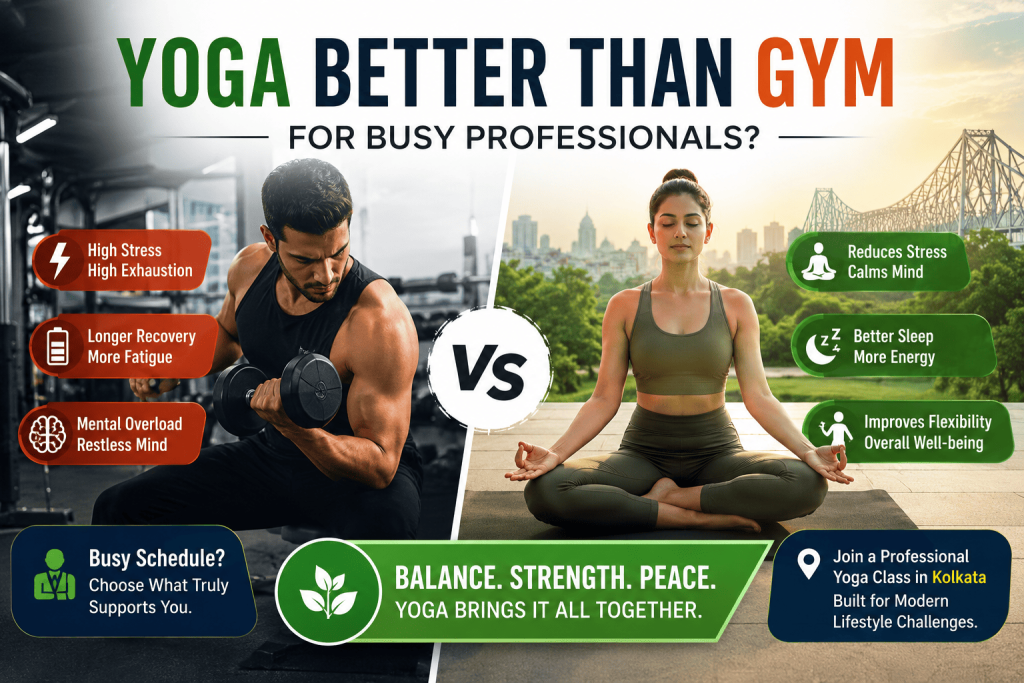
Is Yoga Better Than Gym for Busy Professionals?
For busy professionals dealing with stress, poor sleep, fatigue, neck pain, and mental overload, yoga often becomes more sustainable than intense gym programs. A 45-minute yoga session can improve mobility, calm the nervous system, increase circulation, and reduce mental tension simultaneously.
That does not mean gym workouts are ineffective for professionals. Strength training improves energy levels, confidence, metabolism, and posture. The challenge is recovery. High-stress lifestyles combined with overly aggressive gym routines can increase exhaustion instead of improving health.
This is why hybrid systems are becoming increasingly popular among working professionals in cities like Kolkata. Many people now seek structured wellness routines that combine strength, mobility, mindfulness, breathing exercises, flexibility, and stress management together.
A well-designed yoga class in Kolkata can provide exactly that balance, especially when the instructor understands modern lifestyle challenges rather than teaching yoga only as a traditional ritual disconnected from daily realities.
How Yoga With Sandy Helps People Build Balanced Fitness
At Yoga With Sandy, the focus goes beyond simply teaching poses. The philosophy centers around creating sustainable fitness habits that improve physical strength, flexibility, posture, breathing, mobility, and mental clarity together.
Whether someone joins a yoga class in Kankurgachi, attends online sessions, or explores structured yoga programs in Kolkata, the goal is not just temporary transformation photos. It is long-term wellness that fits into real life.
Modern fitness needs modern solutions. People no longer want burnout-based fitness systems. They want routines they can sustain for years while balancing work, family, stress, sleep, and health.
That is exactly why yoga is no longer seen as separate from fitness. It has become an essential part of complete wellness.
Conclusion
So, is yoga enough for fitness or should you combine gym workouts?
The answer depends on your goals. If your primary aim is flexibility, mobility, stress relief, posture improvement, mindfulness, and sustainable wellness, yoga alone can absolutely keep you healthy and fit. If your goals include major muscle growth, athletic performance, or maximal strength development, gym training becomes highly valuable.
For most people, combining both creates the best long-term results.
Yoga teaches the body how to move. The gym teaches the body how to produce force. Yoga calms the nervous system. Strength training challenges it. Yoga improves flexibility. The gym improves density and power. Together, they create balanced fitness that supports both physical and mental health.
The future of fitness is not “yoga vs gym.”
It is intelligent integration.
